
Why Skincare Should Not Stop at the Jawline
Learn why skincare should continue beyond the jawline to the ears, neck, décolleté, hands and forearms, without making your ritual complicated.

Why Skincare Should Not Stop at the Jawline: Caring for the Neck, Chest and Hands

Most skincare routines are shaped by the mirror. Cleanser, serum and moisturiser are applied carefully across the forehead, cheeks and chin. Then the hands reach the jawline and stop.
Below that point, the neck may receive whatever remains on the fingertips. The upper chest is remembered only when a neckline reveals it. The ears are missed almost entirely, while the hands that performed the ritual are washed and returned to the day.
The boundary feels natural because the face is how skincare is usually presented. Products are photographed beside faces. Tutorials are framed from the shoulders upward. Even the language of a “facial routine” encourages us to think of care as something contained within an oval.
Skin does not recognise that boundary. The ears, neck, décolleté, hands and forearms meet light, weather, cleansing, clothing and daily movement alongside the face. They do not all need identical treatment, but they deserve to be included in the same considered view.
The Jawline Is A Visual Boundary, Not A Skin Boundary
The face receives attention because it is expressive, central and constantly visible. We notice a change in facial texture quickly. We see dryness around the mouth, a patch of uneven tone across the cheek or a shift in comfort after cleansing. The response is immediate because the face is already inside the ritual.
The areas beside it tend to disappear into categories. The neck becomes “body” rather than face. The upper chest is covered for much of the year. Hands are treated as tools, washed repeatedly and given cream only when they feel noticeably dry. Forearms sit somewhere between skincare and bathing, rarely belonging fully to either.
This division is convenient for product shelves, but it is not especially useful for daily care. A more coherent approach follows exposure and experience rather than marketing categories.
The outer ears sit beside the face and remain exposed whenever hair does not cover them. The front and sides of the neck move continuously and meet collars, scarves, perfume and the elements. The décolleté, meaning the upper chest visible above a neckline, can move between complete cover and direct exposure depending on clothing and season. Hands and forearms meet water, soap, sanitiser, surfaces, driving and outdoor light.
None of this means creating five new routines. It means allowing the existing ritual to continue a little further.
Exposure Does Not Stop Where The Face Ends
Skin changes through a combination of time and environment. Research on chronological and sun-induced ageing consistently identifies the face, neck, forearms and backs of the hands among the areas where those influences meet visibly. They are exposed often, but they are not always protected or moisturised with the same consistency as the face.
This uneven attention can create an equally uneven experience. The face may feel comfortable after a carefully layered routine while the neck feels tight. The hands may appear dry soon after washing even though a rich facial moisturiser sits nearby. The ears may receive neither moisturiser nor sunscreen simply because they fall outside the usual application pattern.
Sun protection makes the need for continuity especially clear. Dermatologists recommend applying sunscreen to all skin not covered by clothing, specifically reminding people to include the ears and neck. Hands and forearms also remain exposed through ordinary activities, including walking and driving.
This does not mean that every centimetre needs the same quantity or texture. The principle is awareness. If an area is exposed, include it when applying a separate sunscreen according to its directions. If it feels dry after washing or weather exposure, include it when applying an appropriate moisturising product.
The purpose is not to chase perfect uniformity. It is to reduce the accidental contrast between areas that receive daily care and areas remembered only after discomfort or visible change appears.
The Neck And Décolleté Need A Gentler Continuation
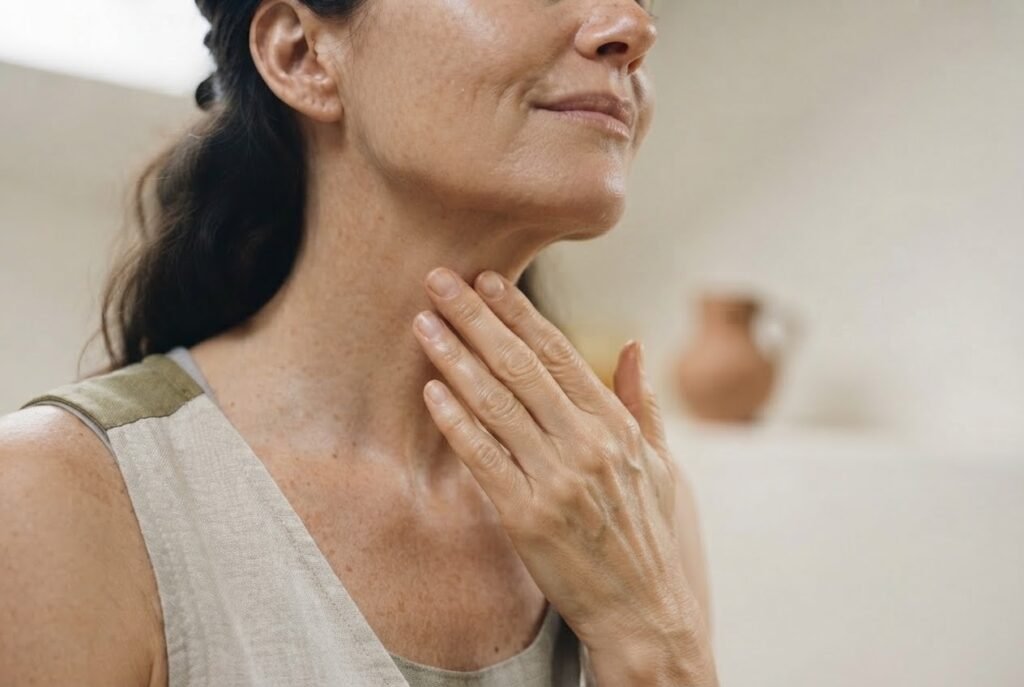
The neck and upper chest have their own structural and exposure considerations, and often benefit from a gentler approach than the face. They move differently, meet different clothing and may respond differently to a product that feels entirely comfortable across the cheeks and forehead.
This matters when the facial routine contains strong exfoliating acids, retinoids or other concentrated treatments. Extending care beyond the jawline does not mean automatically extending every active ingredient at the same amount or frequency. The directions of the specific product should lead, and a new product should be introduced carefully.
The most useful continuity often comes from the quietest steps: gentle cleansing where cleansing is needed, moisturising according to comfort and protecting exposed skin during the day. These actions are less dramatic than a dedicated neck regime, but they are easier to sustain.
Application can also become more attentive. Rather than dragging the remains of a facial product downwards as an afterthought, place a suitable amount across the fingertips and smooth it lightly over the front and sides of the neck and the visible upper chest. Include the area around the jaw and behind the ears when appropriate, without vigorous rubbing or repeated passes.
The décolleté changes with clothing. On a winter day, it may be fully covered; with an open neckline, it becomes part of the exposed skin considered in the morning routine. A responsive ritual notices that difference without turning it into a new collection of products.
Hands And Forearms Carry The Day
Hands experience skincare differently from the face because they are constantly used. They are washed, sanitised, exposed to cleaning products, placed under hot and cold water, taken outdoors and then washed again. Gardening, housework and practical tasks add friction and contact that the face rarely experiences.
Dermatology guidance therefore places particular emphasis on moisturising after handwashing, ideally while the skin is still slightly damp, and on using gloves for cleaning or gardening. These are simple habits, but they acknowledge what hand skin is being asked to do.
The backs of the hands and forearms also receive environmental exposure without always being included in the morning routine. Sleeves provide cover when they are worn, but hands remain visible through most of the day. A considered sun-protection habit includes exposed hands and forearms rather than ending at the wrists or face.
Evening care can be equally straightforward. A small amount of a suitable moisturising product can be smoothed over the backs of the hands, around the fingers and across the forearms where the skin feels dry. The palms may need less depending on the texture and the next activity.
The goal is not a decorative hand ritual detached from real life. It is to make care easy enough to repeat after the very actions that remove it.
My Ritual Continues Beyond My Face
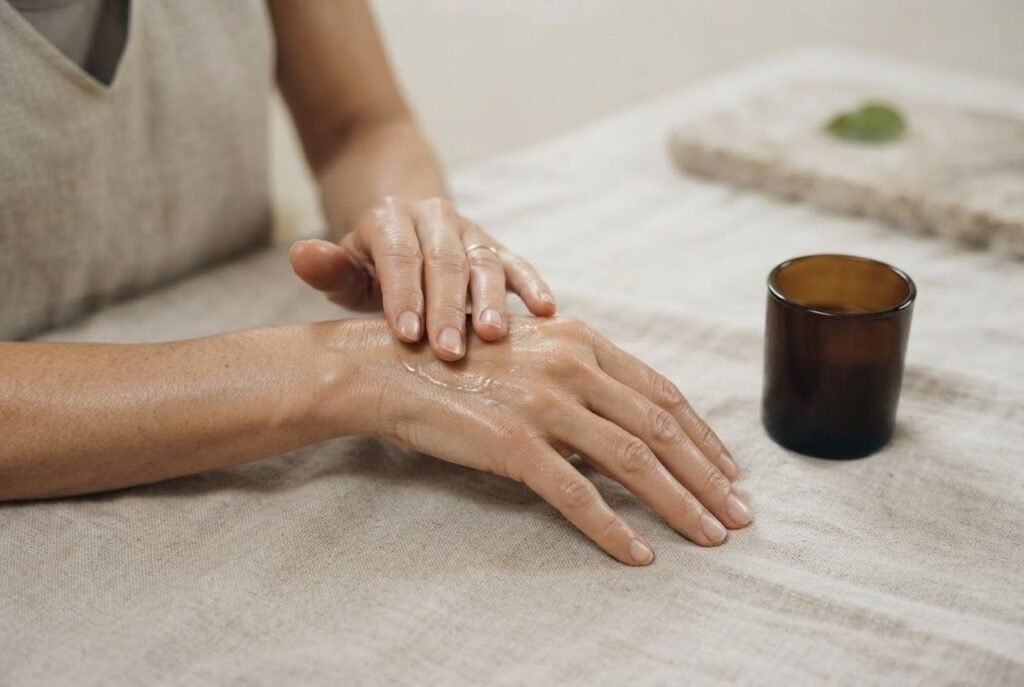
In my own ritual, I apply skincare across my face, ears, neck and décolleté, then continue over my hands and forearms.
I do not think of these as separate zones requiring separate ceremonies. They are simply the visible, exposed areas I want to include when I take care of my skin. Continuing the gesture beyond my jawline feels more natural to me than treating the face as an isolated surface.
The amount and texture still matter. The ears need very little. The neck and décolleté need enough for a light, comfortable layer rather than the residue left after the face. Hands and forearms can take what suits their condition and the time of day. The ritual remains connected, but it is not mechanically identical across every area.
This is also why I value a concise routine. When the ritual contains only purposeful steps, it is easier to extend them with attention. A complicated sequence encourages us to ration time and stop early. A considered sequence leaves room to notice the skin beside the face as well as the face itself.
For me, that continuity is part of care. The face does not receive all the attention while the hands that apply each product are forgotten.
A Simple Ritual From Face To Forearms
A complete ritual for these areas does not need to be long. It needs to distinguish between evening comfort and daytime protection.
In The Morning
1. Apply moisturiser where the skin feels dry or needs additional comfort.
2. Apply a separate sunscreen to all exposed skin according to its directions, including the face, ears, neck, visible décolleté, hands and uncovered forearms.
3. Let clothing do part of the work. Sleeves, collars, shade and other protective choices can reduce how much skin remains directly exposed.
In The Evening
1. Cleanse or rinse areas that carry sunscreen, makeup, sweat or daily residue, using a method appropriate for that area.
2. Apply a water-based moisturising step where needed, particularly after washing.
3. Add an oil-rich layer only where it contributes useful softness or a more comfortable finish.
Adjust Rather Than Accumulate
A product that suits the face may feel too active on the neck or unnecessary on the forearms. A rich hand texture may feel impractical across the palms during the day but welcome before bed. The routine should respond to these differences.
Test unfamiliar products before extending them across a larger area; follow the label and change one element at a time. Continuity of care does not require uniformity of product.
Composition And Restraint Beyond The Face
The expansion of body skincare has encouraged a separate product for almost every visible area. There are dedicated formulas for the neck, chest, hands, arms and even individual lines. Sometimes a specialised format has a practical purpose, but the existence of a category does not prove that every routine needs it.
OssieNaturals approaches care through composition and restraint. A formula should earn its place through the texture, function and experience it contributes. The same principle applies when skincare moves beyond the face.
An oil-rich composition may bring useful slip and softness to dry-feeling forearms or the backs of the hands. A lighter moisturising layer may feel more appropriate across the neck before sunscreen. The decision begins with what the area needs and how the complete routine feels, rather than with a demand to use every product everywhere.
This keeps the ritual coherent. Instead of collecting products around individual anxieties, the reader can begin with a few questions: Is this area exposed? Does it feel dry or uncomfortable? Is the current product appropriate here? Does this extra layer add something useful?
Restraint does not mean neglect. It means extending attention without multiplying noise.
Key Takeaways
- The jawline is a visual boundary, not the natural end of a skincare ritual.
- The ears, neck, décolleté, hands and forearms share daily environmental exposure with the face.
- Extending care does not mean using every facial active across every area.
- Moisturising and appropriate sun protection are the most useful foundations.
- Hands benefit from care that acknowledges repeated washing, practical work and weather exposure.
- One coherent ritual can adapt its amount and texture across different areas without becoming complicated.
A Final Word
Care often becomes uneven through habit rather than intention. We learn to study the face closely while treating the skin beside it as background. The jawline becomes the end of the ritual simply because that is where the tutorial, mirror or product instruction seemed to stop.
Extending skincare beyond that line is a small act of continuity. It asks us to remember the ears beside the face, the neck that carries every movement, the upper chest revealed by a neckline, and the hands and forearms that meet the practical world each day.
They do not need to be corrected, compared or surrounded by new products. They need the same quality of attention we already understand: suitable moisture, appropriate protection, a texture that feels comfortable and enough consistency for the ritual to become natural.
In my own practice, moving from face to ears, neck, décolleté, hands and forearms feels like one continuous gesture. Nothing is rushed, and nothing is treated as an afterthought. The ritual simply follows the skin a little further.
When care is composed this way, it becomes more complete without becoming more complicated. The face remains important, but it no longer receives attention at the expense of everything just beyond its frame.
Explore Products:
Serums
BioLipid Serum Oil™
A lipid-rich composition that supports softness, flexibility, and everyday barrier comfort without ever feeling heavy

Restorative Phyto Serum Oil
All the visible smoothing, firming, and brightening you want. Delivered gently enough for the most reactive complexions.

Nettle Serum Oil™
A lightweight unscented serum oil that helps settle the look of redness and ease the feeling of reactivity.

Balms
Calendula Balm Original
When skin says no to everything else. The simplest, gentlest balm we make — just a quiet seal of comfort for the most sensitive, easily unsettled complexions.
Calendula Balm Plus
Where redness meets dryness. A richer, more restorative calendula balm with rosehip and sea buckthorn to replenish, soften, and support visible renewal.

Seabuckthorn Balm
For skin that feels thinner, more fragile, less resilient. A concentrated restorative balm that helps rebuild a sense of density and protection while supporting lasting comfort.

Scrub
Bio-Refining Scrub
The gentlest kind of renewal. A powder you activate yourself — with water for a light polish or oil for a buffered, nourishing treatment.

Continue Reading
Support Your Skin
Our natural product collection at Ossie Naturals is formulated specifically to support your skin’s natural adaptive processes. Each product provides the building blocks your skin needs, from barrier-supporting lipids to adaptive antioxidants.
We don’t believe in dramatic seasonal routine overhauls or aggressive treatments that fight against your skin’s natural processes. Instead, our approach focuses on gentle, consistent support that works with your skin’s intelligence rather than against it.
Join our private community on Facebook or join our Newsletter for access to seasonal transition guides, ingredient education, and products specifically formulated to support your skin through changes because your skin’s adaptive intelligence deserves support, not interference.
Performance‑led, nutrient‑rich compositions
Our House Collection
Calendula Balm - Original™
Restorative and Calming Concentrate
Azure Tansy
Balm™
Intensive Repair and Protection Complex
TerraPure - Original Deodorant
Powerful protection, naturally

Restorative Phyto‑Serum Oil™
Renewal and Balance. Visible transformation in every drop

We empower your skin to thrive.
Sign Up Newsletter
Ready to invest in your skin’s future with the finest natural ingredients? Explore our collections or join our community for expert tips and exclusive access.
We value your trust when sharing your personal data with us. We always treat your data in a fair and respectful manner, limited to the purpose mentioned above. If you would like to know more about how we handle your data, please read our Privacy Policy.